
Understanding TPMS Systems in Modern Vehicles
How They Work, The Different Types, and the Pros & Cons for Drivers
If you’ve ever seen the yellow horseshoe-shaped warning light pop up on your dash, you’ve experienced your vehicle’s Tire Pressure Monitoring System (TPMS) in action.
TPMS has been mandatory on new vehicles in North America since the late 2000s, and it plays a critical role in safety, tire longevity, and fuel efficiency—especially with our Alberta temperature swings.
In this blog, we’ll break down:
What TPMS is
The two main types of TPMS systems
How each system works
The pros and cons of each
What you should know as a vehicle owner
What Is TPMS?
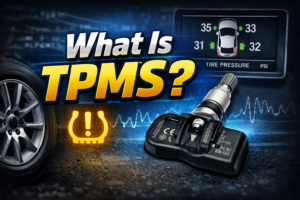
TPMS (Tire Pressure Monitoring System) is an electronic system designed to monitor the air pressure inside your tires and alert you when pressure drops below the manufacturer’s recommended threshold.
Proper tire inflation affects:
Vehicle handling and braking
Fuel economy
Tire wear
Load-carrying capacity
Overall driving safety
Two Types of TPMS Systems
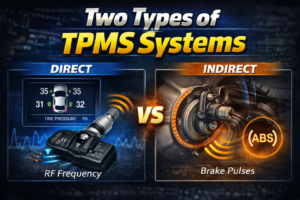
There are two primary types of TPMS used in modern vehicles:
Direct TPMS
Indirect TPMS
Let’s break each one down.
1. Direct TPMS (Sensor-Based System)
How Direct TPMS Works
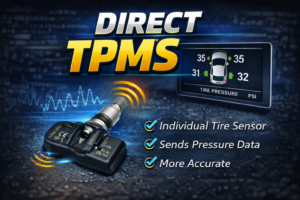
Direct TPMS uses physical pressure sensors mounted inside each wheel, typically attached to the valve stem or strapped to the wheel barrel.
Each sensor:
Measures actual tire pressure (PSI or kPa)
Sends a radio frequency signal to the vehicle’s TPMS control module
Displays pressure readings on the dash (in many vehicles)
Triggers a warning light if pressure drops below threshold
Some advanced systems even show:
Individual tire pressures
Tire temperature readings

Pros of Direct TPMS
✔ Highly accurate — measures actual pressure
✔ Real-time monitoring
✔ Can identify which specific tire is low
✔ Not affected by tire rotations (if relearned properly)
✔ Better overall safety feedback

Cons of Direct TPMS
✘ Sensors have batteries that eventually die (typically 5–10 years)
✘ Higher replacement cost
✘ Sensors can be damaged during tire mounting/dismounting
✘ Requires relearn procedure after rotations or wheel swaps
✘ Winter wheel packages often require additional sensors
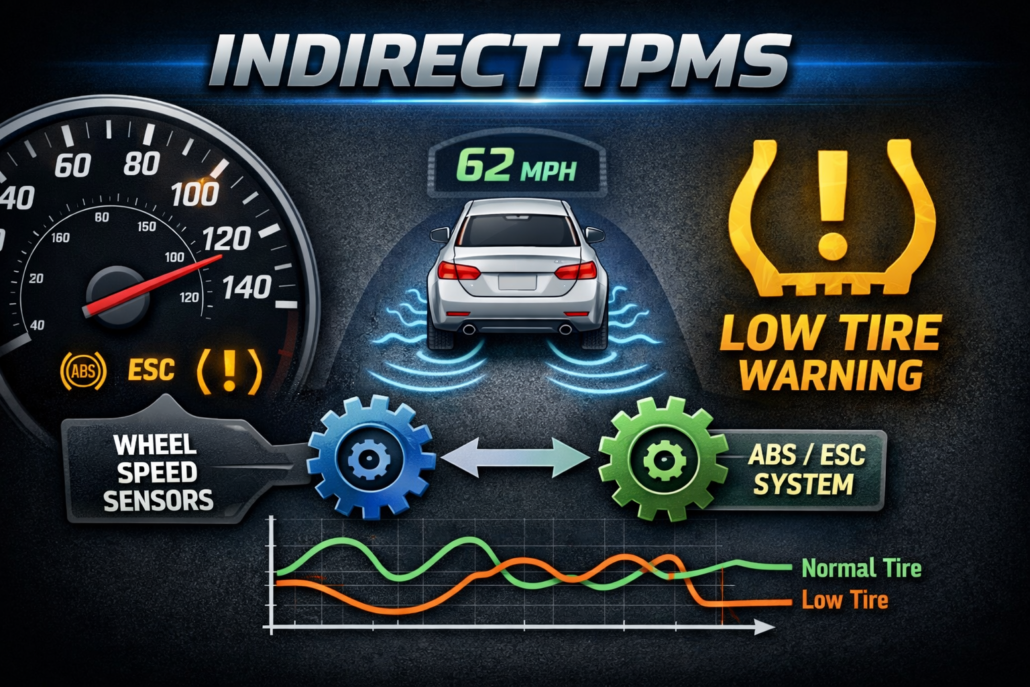
2. Indirect TPMS (ABS-Based System)
How Indirect TPMS Works
Indirect TPMS does not use physical pressure sensors.
Instead, it relies on the vehicle’s ABS (Anti-lock Braking System) wheel speed sensors.
Here’s how it works:
A tire with lower air pressure has a smaller rolling diameter
That tire rotates faster than properly inflated tires
The ABS system detects the difference in wheel speed
The system interprets that difference as low tire pressure
The TPMS warning light turns on
Pros of Indirect TPMS
✔ No internal tire sensors
✔ Lower replacement cost
✔ No sensor batteries to fail
✔ No additional cost for winter wheel packages
✔ Lighter system weight
Cons of Indirect TPMS
✘ Less accurate
✘ Does not display actual PSI
✘ Cannot always identify which tire is low
✘ Requires manual recalibration after adjusting pressures
✘ May not detect equal pressure loss in all four tires

Key Differences at a Glance
| FEATURE | DIRECT TPMS | indirect tpms |
|---|---|---|
| Measures Actual PSI | ✔ Yes | ✘ No |
| Users Physical Sensors | ✔ Yes | ✘ No |
| Battery Replacement Required | ✔ Yes | ✘ No |
| Displays Individual Tire Pressure | Often | Rarely |
| Accuracy Level | High | Moderate |
| Cost of Service | Higher | Lower |

Why TPMS Matters
In climates like Edmonton and Sherwood Park, temperature swings can cause rapid pressure changes.
Rule of thumb:
For every 10°C drop in temperature, tire pressure drops approximately 1–2 PSI.
That’s why you’ll often see TPMS lights appear during seasonal transitions.
Ignoring low tire pressure can lead to:
Uneven tread wear
Reduced traction
Poor fuel economy
Increased stopping distance
Potential tire failure
Common TPMS Questions
Why is my TPMS Light on, but my tires look fine?
Tires can be 20% underinflated and still appear visually normal. Always verify with a calibrated tire gauge.
Can I ignore the TPMS Light?
Technically yes.
Advisable? No.
The system is part of your vehicle’s safety network.
What happens if a TPMS sensor fails?
Direct systems will trigger a flashing TPMS light
The sensor must be replaced and programmed
Driving is still possible, but monitoring is lost

Final Thoughts: Which System is Better?
From a technical standpoint:
Direct TPMS is more accurate and safety-focused
Indirect TPMS is simpler and lower-cost
Most modern vehicles use direct TPMS due to regulatory standards and improved safety performance.
For customers running:
Aftermarket wheels
Winter tire packages
Lifted trucks
Larger off-road tires
It’s important to ensure sensors are properly programmed and compatible with the vehicle’s system.